

AI in Food Processing Market Size to Reach USD 138.26 Billion by 2034, Driven by Rising Automation and Safety Demands
According to Towards FnB, the global AI in food processing market size is evaluated at USD 14.78 billion in 2025 and is expected to skyrocket to USD 138.26 billion by 2034, growing at an impressive CAGR of 28.2% from 2025 to 2034. This rapid growth highlights the increasing adoption of AI technologies in the food processing sector.
Ottawa, Nov. 03, 2025 (GLOBE NEWSWIRE) -- The global AI in food processing market size stood at USD 11.53 billion in 2024 and is predicted to increase from USD 14.78 billion in 2025 to USD 138.26 billion by 2034, according to a report published by Towards FnB, a sister firm of Precedence Research. This growth reflects the expanding role of artificial intelligence in revolutionizing the way food is processed and managed globally.
The market is observed to grow as AI has proved to be an innovation in food manufacturing by developing safety standards and quality control. Automated systems lower down human error and ensure constant quality across different batches.
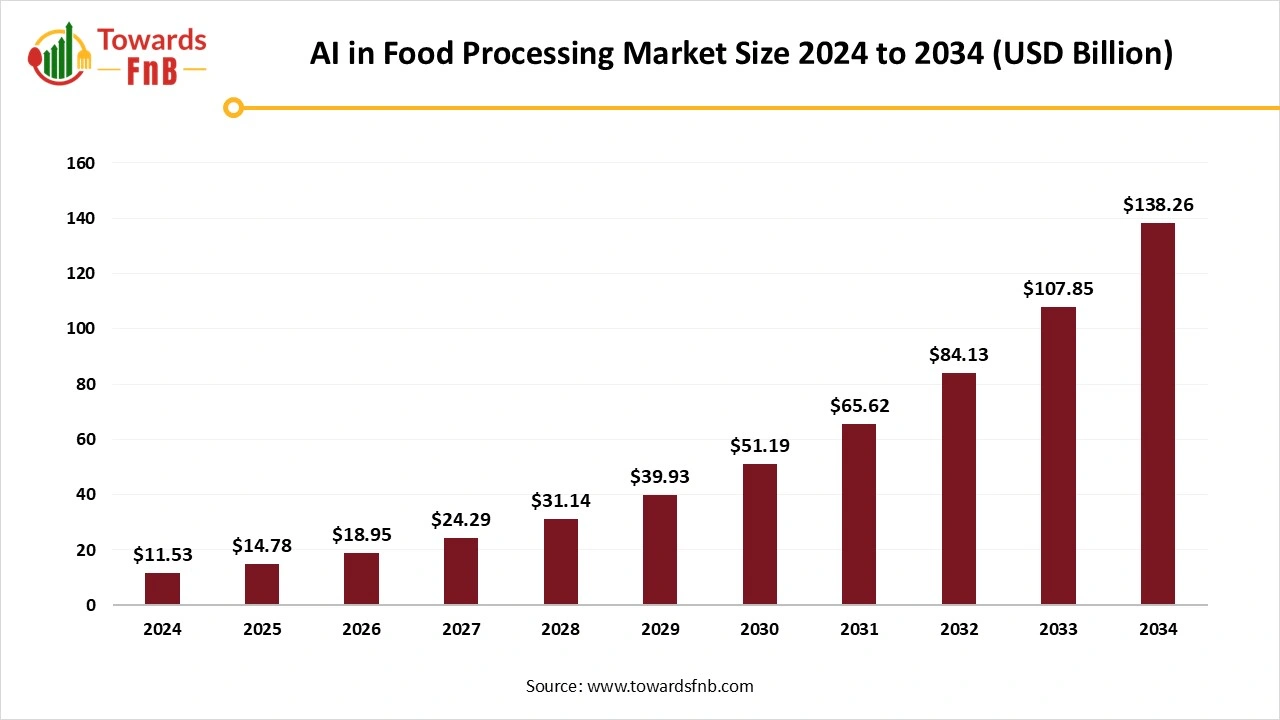
Note: This report is readily available for immediate delivery. We can review it with you in a meeting to ensure data reliability and quality for decision-making.
Access the Full Study Instantly | Download Sample Pages of the Report Now@ https://www.towardsfnb.com/download-sample/5890
How AI is Transforming Food Processing Market ?
AI-powered agriculture is assisting farmers in updating planting schedules, pesticide usage, and irrigation, too -by lowering the waste and developing yields. AI-based sensors and satellite imagery can track crop stress or disease early, which allows timely interventions and protects food security.
Users -experiencing inventions are also developing. AI is tailoring meal suggestions and nutritional guidance depending on the dietary restrictions or health goals. Food organisations use AI to track trends from social media, buyers, and reviews in order to make products that align with developing tastes.
In production and processing, AI models track hygiene, temperature compliance, and shelf life in order to develop food safety. Robotics mixed with computer vision is now updating packaging and grading work, lowering labor reliance and reducing human error.
AI in Food Processing Market Key Highlights
- By region, North America captured the largest share of the global AI in food processing market, representing around 42% in 2024, while Asia Pacific is projected to experience the fastest growth during the forecast period.
- By AI technology, the machine learning/deep learning segment held a significant market share of approximately 40% in 2024, whereas computer vision & image recognition is expected to grow at a steady CAGR between 2025 and 2034.
- By application, the food quality & safety inspection segment led the market, accounting for about 45% of the revenue in 2024, while process optimization & automation is projected to grow at a robust CAGR during the forecast period.
- By food type, processed and packaged foods dominated with a share of approximately 40% in 2024, while the meat, poultry, and seafood segment is expected to grow steadily from 2025 to 2034.
- By deployment, cloud-based AI platforms generated around 55% of the market revenue in 2024, whereas on-premise/edge AI solutions are forecasted to grow at a strong CAGR between 2025 and 2034.
- By end user, food manufacturers & processors accounted for roughly 60% of the market revenue in 2024, while logistics & cold chain operators are projected to grow significantly during the forecast period.
“AI adoption in food processing is shifting from experimentation to execution,” said Vidyesh Swar, Principal Consultant at Towards FnB. “Early adopters in quality inspection and labeling report 6–9 month payback periods and up to 18% defect reduction within the first year.”
Major Importers of AI in Food Processing Market
- North America: The top industry for AI in terms of food processing is growing in this region due to high-level technological infrastructure, early acceptance of AI, a big concentration of tech companies, and rigid food safety regulations.
- Asia Pacific: The Asia Pacific region is another major importer as it has fast urbanization, a developing middle class with higher demand for quality food, and developed government and business investments in terms of advanced technology.
-
Europe: A main importer region that concentrates on AI invention, sustainability in food manufacturing, and regulatory compliance, too.
View Full Market Intelligence@ https://www.towardsfnb.com/insights/ai-in-food-processing-market
Traditional vs. AI-driven Approaches in Food Quality Monitoring:
| Feature | Traditional Method | AI-Enhanced Method |
| Detection and Contaminant | Lab sampling, manual checks | Computer vision, real-time sensor data analysis. |
| Traceability | Batch codes, manual records | Blockchain integration and rapid data processing. |
| Shelf-life | Empirical testing and static dates | Fast prediction depending on many variables. |
| Risk Assessment | Manual audits and historical analysis. | It has a predictive modeling pattern that relies on different data streams. |
| Speed | Labor-intensive and slow | Near actual-time or real-time |
| Accuracy | It is restricted by human error and sampling, too. | High accuracy through data and sensor fusion. |
| Scope | Batch-particular or limited sampling | Constant tracking across manufacturing and supply chain. |
New Trends of AI in the Food Processing Market
- Food Preparation: Having labor shortages and big turnover in the food sector, cafes are heavily accepting AI-driven automation to improve efficiency and align with user demand for convenience. AI-powered robotic chefs can now track ingredients, ensuring food safety, and speed up the cooking times without human mediation. From ChatGPT-made recipes to high-level robotic cooking systems, AI is changing food preparation by making it quicker, easier, and safer, too.
- Healthier Diets: AI is changing nutrition, which makes healthier diets more acceptable and sustainable. Machines like Fuddle, an AI-powered meal tracker and cookbook assistant, assist consumers in making tailored recipes depending upon dietary needs, available ingredients, and allergies. Likely, an AI-driven tailored nutrition app, RxDiet, makes tailored food plans and serves fresh ingredients.
- AI in Food Distribution: As food costs increase due to the latest tariffs and labor shortages continue, several distributors are seeking ways to cut costs and develop consistency. Choco, which is a startup dependent on developing the food supply chain, has revealed the AutoPilot, an AI tool that assists food distributors in processing orders without manual intervention.
- Quality Control and Food safety: AI is updating food checking and quality assurance, developing contamination detection, ensuring product consistency, which updates the shelf-life expectations, compliance tracking, and risk prediction to develop the safety and public health.
-
AI in Fast Food Operations: Artificial Intelligence is rapidly updating the fast-food sector, developing efficiency and changing customer expectations. Over the last years, AI-powered kiosks, drive-thru automation, digital menus, and delivery inventions have become standards, with main challenges that include updating and investing in next-generation technology.
AI in Food Processing Market Dynamics
Opportunity
Requirement of Reliable Solutions in Food Management
Artificial Intelligence, in terms of food processing and production, helps with food manufacturing planning and scheduling of manufacturing lines. With the help of ERP usage, producers can develop real-time data analytics to check machine failure and avoid manufacturing downtime. Apart from this, food AI can track pollutants in food production, ensuring quality control and food safety compliance. Also, the AI in food processing is accountable for driving sustainability initiatives of the food business in several ways that are unimaginable before. By concentrating on resource consistency, AI is allowing perfect water and energy usage. With the assistance of food manufacturing and resource tracking, companies are using AI to lower waste and follow eco-friendly and sustainable practices.
Challenge
High Cost of Implementation
Several companies are challenged by the technical problems and the cost of adopting AI. Research and the assistance of an AI consulting organization are needed while integrating AI solutions. The organisations should conduct pilot tests and check the capability and smoothness of the AI technologies before implementing them on a large scale. Also, the food sector is expected to have rigorous safety and quality controls. Organizations must check these regulatory scenarios when using AI solutions, making sure that they are in compliance with all the regulations. Partnerships with industry consultants and legal experts can assist organizations in staying in compliance and safety.
For Detailed Pricing and Tailored Market Report Options, Click Here: https://www.towardsfnb.com/checkout/5890
AI in Food Processing Market Regional Analysis
North America Led the Market with the Largest Share in 2024
The use of Artificial Intelligence (AI) in the North American food processing industry is updating operations across the supply chain. One of the most crucial areas of AI implementation is in food safety and quality control. AI systems filled with computer vision are being utilised to check products for pollutants and defects, and to reduce human error, resulting in higher quality and fewer recalls.
Furthermore, AI-powered sensors and predictive tracking play an important role in checking storage conditions, such as humidity and temperature, to ensure food safety and extend the shelf life.
In terms of food processing, automation driven by AI develops smoothness and minimizes waste, specifically in terms of repetitive tasks like slicing, sorting, and packaging. As consumer safety standards and regulatory compliance continue to evolve, organisations are shifting to AI solutions to track constant quality and streamline their auditing procedure.
Asian Countries to Grow at the Fastest Rate with Rapid Adoption of AI in Food Industry
This region is one of the biggest usage segments for AI in food processing in the Pacific region. The AI-powered visual display systems use deep learning in order to check contaminants, pollutants, and quality problems with high accuracy, surpassing manual inspection. Japanese food company Kewpie uses Google’s TensorFlow for checking anomalies in diced potatoes for baby food.
It is integrated with blockchain to make traceable and transparent supply chains. This assists in tracking food from farm to table, develops recall smoothness, and constructs user trust, too. AI-powered object and facial checking software tracks employees in real-time to make sure they follow hygiene protocols, such as wearing gloves and masks, which is important for food safety.
Europe to Boom Rapidly with Growing Demand for Supply Chain Solutions in Food Sector
The demand for Artificial Intelligence in European food processing is being driven by the demand for bigger sustainability, smoothness, and safety in response to user demand and labor shortages. The industry is rapidly developing, with AI solutions that are being used across the supply chain, from manufacturing to packaging. So, the European users are heavily favoring tailored, high-quality food products, which are healthy too, which drives the demand for AI-driven solutions. Main funding from the European organizations and research colleges is being used to develop AI inventions in terms of the food and beverage industry.
AI in Food Processing Market Report Scope
| Report Attribute | Key Statistics |
| Base Year | 2024 |
| Forecast Period | 2025 to 2034 |
| Growth Rate from 2025 to 2034 | CAGR of 28.2% |
| Market Size in 2025 | USD 14.78 Billion |
| Market Size in 2026 | USD 18.95 Billion |
| Market Size by 2034 | USD 138.26 Billion |
| Dominated Region | North America |
| Fastest Growing Region | Asia Pacific |
| Regions Covered | North America, Europe, Asia-Pacific, Latin America and Middle East & Africa |
Have Questions? Let’s Talk—Schedule a Meeting with Our Insights Team: https://www.towardsfnb.com/schedule-meeting
AI in Food Processing Market Segmental Analysis
AI Technology Analysis
The machine learning or deep learning segment led the market in 2024 because deep learning is updating food processing by allowing high-level automation, updating the supply chain, and developing quality control. By training the neural networks on big datasets, these kinds of machines can perform complicated and human-like tasks with greater accuracy, speed, and consistency. High-level imaging systems, such as X-ray, thermal imaging, and hyperspectral, are linked with deep learning in order to check foreign objects, such as glass, metal, or plastic pollutants, in packaged foods.
The computer vision and Image recognition segment is predicted to grow fastest during the forecast period because the acceptance of computer vision and image recognition beyond food processing affects a wide range of sectors. Computer vision is utilised to assess crop health, update harvesting procedures, and track development. For example, drones are filled with computer vision that can manage big fields to check areas that need attention. Also, the retailers utilise computer vision to track inventory, ensure compliance with food safety regulations, and track the shelf life.
Application Analysis
The food quality and safety inspection segment led the AI in food processing market in 2024, as food quality assurance is important for checking that food products align with established safety and quality standards. It makes sure that food integrity throughout the supply chain, ensures public health, tracks adherence to regulations, and develops brand reputation. So, the food quality and safety inspection process identifies and eliminates the capability risks like chemical residues, bacterial pollutants, and foreign objects from food, making sure only safe items reach the market, by lowering the chances for foodborne illness.
The process optimization and updation segment is observed to grow in the foreseen period due to process updation in terms of food processing, which includes the systematic tracking and refining in order to develop efficiency, increase profitability, lower waste, and develop product quality and safety too. It can range from simple adjustments in batch recipes to using high-level technologies like Artificial Intelligence in order to manage manufacturing lines in real-time. Producers utilise procedure optimization in order to check and avoid bottlenecks, boost output, and smooth the workflows.
Food Analysis
The processed and packaged food segment led the AI in food processing market in 2024, as packaged food updating is utilized in terms of food processing in order to stretch the shelf life, develop food safety, develop process efficiency, align with sustainability goals, and reduce costs. This is achieved through high-level materials, smart technologies, and automated processes that develop the design and function of the packaging.
Modified atmosphere packaging substitutes the air inside the package with an updated gas blend that has gases such as carbon dioxide or nitrogen. This lowers oxidation and microbial development, which stretches the shelf life of sensitive goods like cheese, meat, and fresh produce. It has characteristics like special locks and breakaway closures, which protect items from unauthorized access, and reassure the integrity and safety of the products, too.
The meat, poultry, and seafood segment is predicted to grow fastest during the forecast period. Meat and seafood processing is updating quickly with high-level technologies that align with strict sustainability, safety, and product consistency standards. These inventions assist in developing the efficiency, track high quality in a margin-sensitive market, and reduce labor costs too. In order to keep the industry competitive, processors now depend on automation, High Pressure Processing (HPP), Artificial Intelligence, and ultrasound systems to ensure smooth operations.
Deployment Analysis
How cloud-based AI platforms have dominated the AI in food processing market in 2024, as cloud computing is not just developing the delivery logistics, but also updates food safety. The U.S Food and Drug Administration (FDA) has used cloud technology in order to launch its OpenFDA platform. This cloud-dependent machine enables the fastest searches, queries, and reclamation of huge datasets directly from the FDA’s records, which ensures that food safety standards are aligned more smoothly. Among these moves, cloud computing has become the foundation of the food sector. It’s not just about keeping up with technology but also about developing the work for everyone. From updating delivery routes to just ensuring food safety with real-time data, the effect is intense.
The on-premises /AI-edge solutions are expected to grow in the foreseen period. Regular manual inspections can be slow and not constant due to human error and the huge amount of data. AI-edge systems serve superior accuracy and speed for quality control through computer vision and deep learning. So, the AI-powered machine vision systems can check and remove foreign objects or pollutants that can be missed by the naked eye. High-resolution sensors and cameras on manufacturing lines can quickly scan thousands of products for issues like size inconsistencies, discoloration, or cracks in items such as fruits, snacks, and even eggs.
By End-use Analysis
The food manufacturers and processors segment dominated the AI in food processing market in 2024, as the food processing and manufacturing industry is huge and diverse, encompassing various industries. Manufacturers and processors are an important element of the food supply chain, which takes the raw food materials from upstream manufacturers and transforms them into user goods and ingredients for distribution. Corporate achievement in the food processing and producing sector depends on a strong understanding of the competitive scenario, regulatory needs, commodity prices, supply chain dynamics, and growing user preferences. Organizations whose goal is to protect the competitive edge must search for new ways in order to increase efficiencies, reduce food waste, and apply industry trends.
The logistics and cold chain operators segment is expected to grow in the foreseeable period. By using accurate storage, distribution practices, and transportation, cold chain logistics assist in lowering food waste by making sure that food reaches the user in optimal condition. This not only develops food safety and quality but also contributes to overall sustainability efforts in the food sector. The usage of the technology in terms of cold chain logistics has further changed the way food safety and quality are ensured. Inventions such as real-time tracking systems, monitoring devices, and data analytics have developed the reliability and smoothness of the cold chain operations.
Recent Developments in AI in the Food Processing Market
- In April 2025, Fujitsu Ltd, Sonaofai Inc, Ishida Tec Co Ltd, and Tokai University have revealed the launch of an automated inspection machine that checks the fastest content of the frozen albacore tuna in a non-destructive manner. The machine, which includes Fujitsu’s AI technology, is being revealed by Sonafai Inc., a Japanese startup that is committed to storing artisanal procedures through digital invention. (Source: https://www.fujitsu.com)
- In September 2025, the Tomra 4C with LUCAI is an updated optical sorting machine that is crafted and updated in order to develop accuracy, detection, performance, flexibility, and smoothness for the IQF and nut sectors. (Source: https://thepackman.in)
- In July 2025, Nestlé R&D is collaborating with IBM Research in order to make new machines that develop the power of Artificial Intelligence and deep tech to serve innovative inventions in life. This research partnership has led to the growth of a generative AI tool that can classify novel high-barrier packaging materials. (Source: https://www.nestle.com)
- In July 2025, FloVision Solutions, which is a startup serving AI-powered yield and quality management for protein manufacturing to the worldwide food sector, revealed it has developed USD8.7 million in Series A funding. The round is led by overall software investor Insight Collaborative, that have the participation from Serra Ventures, Rockstart, and SOSV.
- In September 2025, ICAR-Indian Agricultural Research Institute(IARI), New Delhi, revealed the week-long Agripreneurship Development Program (ADP) in order to assist young innovators and startups in the food processing industry.
- In March 2025, GrubMarket, the AI-powered technology that allows digital changes in the American food supply chain sector, as well as one of the biggest private food eCommerce organizations globally, announced the launch of AI model configuration and Company Dictionary for the GrubAssist AI.
Feel Free to Get in Touch with Us for Orders or Any Questions at: sales@towardsfnb.com
Additional Topics Worth Exploring:
- Tea Market: The global tea market size is projected to expand from USD 30.25 billion in 2025 to USD 54.68 billion by 2034, growing at a CAGR of 6.8% during the forecast period from 2025 to 2034
- Beverage Packaging Market: The global beverage packaging market size is projected to reach USD 271.80 billion by 2034, growing from USD 173.71 billion in 2025, at a CAGR of 5.1% during the forecast period from 2025 to 2034.
- Gluten Free Food Market: The global gluten free food market size increasing from USD 14.25 billion in 2025 and is expected to surpass USD 33.59 billion by 2034, with a projected CAGR of 10% during the forecast period from 2025 to 2034.
- Canned Wines Market: The global canned wines market size is expected to increase from USD 127.88 million in 2025 to USD 332.46 million by 2034, growing at a CAGR of 11.2% throughout the forecast period from 2025 to 2034.
- Plant-Based Protein Market: The global plant-based protein market size is projected to expand from USD 20.33 billion in 2025 and is expected to reach USD 43.07 billion by 2034, growing at a CAGR of 8.7% during the forecast period from 2025 to 2034.
- Bakery Product Market: The global bakery product market size is rising from USD 507.46 billion in 2025 to USD 821.62 billion by 2034. This projected expansion reflects a CAGR of 5.5% during the forecast period from 2025 to 2034.
- Coconut Products Market: The global coconut products market size is expected to climb from USD 14.18 billion in 2025 to approximately USD 33.71 billion by 2034, growing at a CAGR of 10.1% during the forecast from 2025 to 2034.
- Pet Food Market: The global pet food market size is expected to increase from USD 113.02 billion in 2025 to USD 167.97 billion by 2034, growing at a CAGR of 4.5% throughout the estimated timeframe from 2025 to 2034.
-
Organic Food Market: The global organic food market size is expected to grow from USD 253.96 billion in 2025 to USD 660.25 billion by 2034, with a compound annual growth rate (CAGR) of 11.20% during the forecast period from 2025 to 2034.
Top Companies in the AI in Food Processing Market
- Siemens AG – Offers advanced automation and AI-driven process optimization solutions for food and beverage manufacturing to improve quality, energy efficiency, and predictive maintenance.
- Google – Provides powerful AI and machine learning platforms through Google Cloud, enabling food companies to leverage data analytics for demand forecasting, supply chain optimization, and quality control.
- Honeywell International Inc. – Delivers smart manufacturing systems and AI-based process automation for improved production safety, energy management, and efficiency in food processing facilities.
- Rockwell Automation – Specializes in industrial automation and AI-integrated control systems that enhance productivity, minimize downtime, and ensure consistent food product quality.
- ABB Ltd – Offers robotics and AI solutions for food packaging, handling, and processing operations, focusing on precision, hygiene, and operational flexibility.
- Baumer Group – Provides intelligent sensors and AI-enabled machine vision technologies for quality inspection, sorting, and monitoring in food production lines.
- Cognex Corporation – A leader in AI-powered machine vision and deep learning inspection systems that detect defects, verify labels, and ensure consistency in food manufacturing.
- Bühler Group – Integrates AI and digital process control in grain milling, food safety, and ingredient processing to increase yield and reduce waste.
- FANUC Corporation – Supplies AI-enabled robotics and automation systems that enhance speed, precision, and safety in food packaging and material handling.
- SAP SE – Offers enterprise AI and data analytics solutions that help food processors improve supply chain transparency, traceability, and operational efficiency.
- Zebra Technologies – Provides AI-driven tracking, barcode, and data capture technologies to enhance inventory management, logistics, and food traceability.
- Sight Machine – Specializes in AI-powered manufacturing analytics platforms that transform real-time production data into insights for improving yield and reducing downtime.
-
Intello Labs – Focuses on AI and computer vision solutions for food quality assessment, using image analysis to evaluate freshness, ripeness, and grading of agricultural produce.
Segments Covered in the Report
By AI Technology
- Machine Learning / Deep Learning
- Computer Vision & Image Recognition
- Robotics & Automation
- Predictive Analytics & Big Data
- Natural Language Processing (NLP) & Voice AI
By Application
- Food Quality & Safety Inspection
- Defect Detection
- Contaminant/Foreign Object Detection
- Process Optimization & Automation
- Mixing/Cooking/Baking Process Control
- Energy & Resource Optimization
- Supply Chain & Inventory Management
- Demand Forecasting
- Cold Chain Monitoring
- Packaging & Labeling Automation
- Automated Labeling
- Package Integrity Inspection
By Food Type
- Dairy & Dairy Products
- Bakery & Confectionery
- Meat, Poultry & Seafood
- Fruits & Vegetables
- Beverages
- Processed/Packaged Foods
By Deployment Model
- Cloud-based AI Platforms
- On-premise/Edge AI Solutions
- Hybrid Models
By End User
- Food Manufacturers & Processors
- Food Retail & Distribution
- Logistics & Cold Chain Operators
- Research & Testing Labs
By Region
North America
- U.S.
- Canada
Asia Pacific
- China
- Japan
- India
- South Korea
- Thailand
Europe
- Germany
- UK
- France
- Italy
- Spain
- Sweden
- Denmark
- Norway
Latin America
- Brazil
- Mexico
- Argentina
Middle East and Africa (MEA)
- South Africa
- UAE
- Saudi Arabia
- Kuwait
Thank you for exploring our insights. For more targeted information, customized chapter-wise sections and region-specific editions such as North America, Europe, or Asia Pacific—are also available upon request.
For Detailed Pricing and Tailored Market Report Options, Click Here: https://www.towardsfnb.com/checkout/5890
Feel Free to Get in Touch with Us for Orders or Any Questions at: sales@towardsfnb.com
Unlock expert insights, custom research, and premium support with the Towards FnB Annual Membership. For USD 495/month (billed annually), get full access to exclusive F&B market data and personalized guidance. It’s your strategic edge in the food and beverage industry: https://www.towardsfnb.com/get-an-annual-membership
About Us
Towards FnB is a global consulting firm specializing in the food and beverage industry, providing innovative solutions and expert guidance to elevate businesses. With an in-depth understanding of the dynamic F&B sector, we deliver customized market analysis and strategic insights. Our team of seasoned professionals is committed to empowering clients with the knowledge needed to make informed decisions, ensuring they stay ahead of market trends. Partner with us as we redefine success in the rapidly evolving food and beverage landscape, and together, we’ll navigate this transformative journey.
Web: https://www.towardsfnb.com/
Our Trusted Data Partners
Precedence Research | Statifacts | Towards Packaging | Towards Chemical and Materials| Nova One Advisor | Food Beverage Strategies | FnB Market Pulse | Nutraceuticals Func Foods | Onco Quant | Sustainability Quant | Specialty Chemicals Analytics
For Latest Update Follow Us:
Discover More Market Trends and Insights from Towards FnB:
➡️Beverage Flavors Market: https://www.towardsfnb.com/insights/beverage-flavors-market
➡️Salt Market: https://www.towardsfnb.com/insights/salt-market
➡️Probiotic Food Market: https://www.towardsfnb.com/insights/probiotic-food-market
➡️Protein Bar Market: https://www.towardsfnb.com/insights/protein-bar-market
➡️Gluten-Free Bakery Market: https://www.towardsfnb.com/insights/gluten-free-bakery-market
➡️Europe Nutraceuticals Market: https://www.towardsfnb.com/insights/europe-nutraceuticals-market
➡️Canned Food Market: https://www.towardsfnb.com/insights/canned-food-market
➡️Non-Alcoholic Beverages Market: https://www.towardsfnb.com/insights/non-alcoholic-beverages-market
➡️Dry Fruit Market: https://www.towardsfnb.com/insights/dry-fruit-market
➡️Frozen Meat Market: https://www.towardsfnb.com/insights/frozen-meat-market
➡️Fish Oil Market: https://www.towardsfnb.com/insights/fish-oil-market
➡️Soft Drink Concentrates Market: https://www.towardsfnb.com/insights/soft-drink-concentrates-market
➡️U.S. Halal Food Market: https://www.towardsfnb.com/insights/us-halal-food-market


Legal Disclaimer:
EIN Presswire provides this news content "as is" without warranty of any kind. We do not accept any responsibility or liability for the accuracy, content, images, videos, licenses, completeness, legality, or reliability of the information contained in this article. If you have any complaints or copyright issues related to this article, kindly contact the author above.
